Chapter 4.3 - First Steps
One chapter down, eight to go.
Now that 4.2 is successfully roughed out, I’m shifting my focus to the hunt for Othman. I’ve spent a lot of time thinking about what this should look like, considering both modern manhunts and how they’re portrayed in fiction.
As I mentioned in Chapter Four Sticking Points, the “man hired to find a wayward child” plot has a long and distinguished pedigree; over the past few months I’ve reviewed a few more of these stories and given some thought about how they operate and where I think there’s some opportunities to try something slightly different.
By my reckoning, these typically break down into four important sections: the request, the search, the discovery, and the retrieval/return, with a possible prologue and epilogue on either end. The search in Chapter 4 is broken into two major sections: figuring out where Othman is, and then actually going and getting him. Chapter 4.3 is where the former happens.
In order to do this properly, however, I need to unsolve a puzzle.
Reverse Detection
Serafin needs to find Othman. Fortunately, I wrote a detailed blog post about Othman last year in anticipation of this, and Chapter 4.3 is where that work begins to pay off. Even though he’ll never appear in person, Othman is still the focus of the chapter.
I know quite a bit about Othman. But how do I share that information? This is a challenge I’ve frequently encountered while working on Razors – figuring out how to parcel out information in the correct way to keep the reader engaged.
Essentially, this is a mystery, a journey from ignorance to expertise. For this chapter, I’ll need to essentially solve that mystery in reverse. I know Othman is concerned about the residents of Collins, but how do I convince the reader? Or Serafin, for that matter? And it may be helpful to go the other direction instead: one cannot arrive at the truth without considering multiple possibilities, some of which are necessarily false.
Let’s briefly review the essential facts of the Othman case:
- Othman ran away from home.
- Othman abandoned his life of wealth and privilege.
- Othman took advantage of his elite network to do so.
- Othman is ideologically motivated.
- Othman traveled to Collins.
- Othman cares about the residents of Collins.
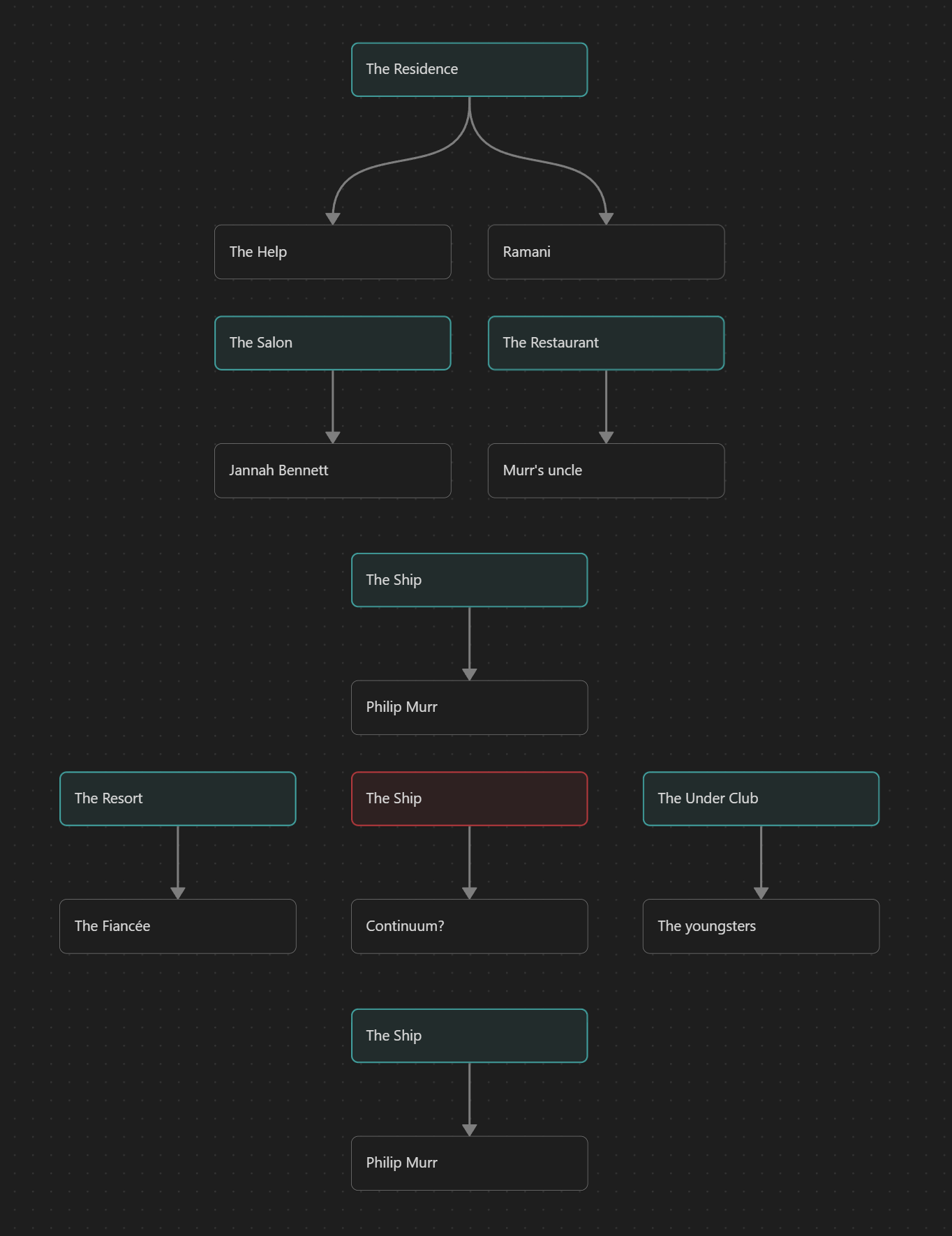
The first two are already known, the third will be fairly obvious; the rest will be more complicated and more difficult to uncover. But a smooth path wouldn’t be satisfying – a hunt requires a hunting ground. In previous chapters, we’ve been limited to a single location, but Chapter 4 is going to feature some stellar jet-setting before we arrive at our final destination. Locations for this chapter include:
- THE RESIDENCE
- THE SALON
- THE RESTAURANT
- THE RESORT
- THE CLUB
- THE SHIP
In short: Othman’s life, Othman’s escape, Othman’s watchers, Othman’s hideout, Othman’s trail, and home base. Each offers a piece of the puzzle, but not all of the pieces may fit together neatly. In fact – it would probably make sense for Othman to throw down some decoys and diversions to keep people off the scent.
In the earliest outline of Chapter 4, I imagined Othman as something of a gullible, sheltered rich idiot who had fallen in love, run away from home, and gotten himself in over his head. I think there’s value in that: if it’s my first instinct, it’s likely to be the reader’s first instinct as well.
One thing I want to explore in this chapter is bias and perception. Othman’s father believes his son is an idiot; Othman’s aunt believes he’s a romantic. Everyone is carrying around an idea of Othman in their head, which blinds them to the truth. As the sub-chapter unfolds, Serafin will hear that Othman is rich. Othman is greedy. Othman is smart. Othman is a criminal. Othman is stupid. Othman is romantic. Othman is a patriot. Othman is a mercenary. Othman is dangerous.
And ultimately, Serafin will need to assemble the fragments to figure out where Othman has gone. Philip Murr, Serafin’s first recruit, will also be valuable here; he can provide an additional perspective and offer an alternate hypothesis.
Structure
I’ve developed a possibly unhealthy and maladaptive fixation on structure over the years, to the point where I don’t feel confident about what I’m working on until I can, in a synesthetic sense, feel the structure of what I’m doing. This unfortunate superstition has only been exacerbated by my reading of John McPhee’s Draft No. 4; I felt an absolute thrill of recognition when I stumbled upon some of the diagrams illustrating the mental outlines of his essays:
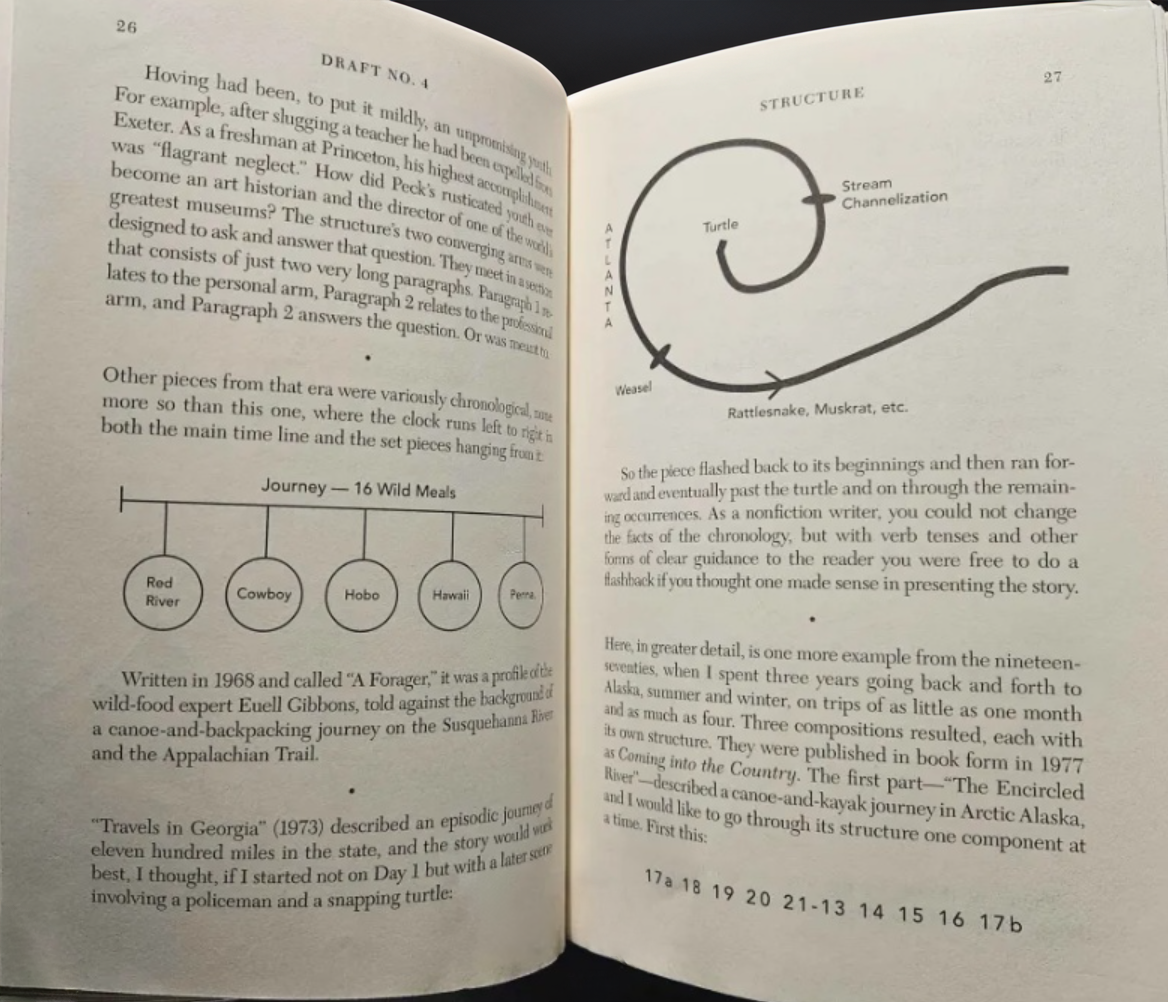
McPhee also has this to say, and I agree:
Readers are not supposed to notice the structure. It is meant to be about as visible as someone’s bones. And I hope this structure illustrates what I take to be a basic criterion for all structures: they should not be imposed upon the material. They should arise from within it. That perfect circle was a help to me, but it could be a liability for anyone trying to impose such a thing on just any set of facts. A structure is not a cookie cutter.
I struggled with Chapter 3.3 tremendously until I hit upon using the overrides as a guideline. I haven’t really found a shape that feels perfect for 4.3, but I am confident each section should consist of a location and a conversation. I may also slip the initial confrontation with Continuum in as well, but I’m reluctant to commit to that until I actually get to that point in the narrative.
Serafin
I try to step back every now and then to make sure what I’m doing helps reveal more about Serafin and moves him along in his journey. I believe the skiptrace helps with this for a few reasons:
As I’ve mentioned before, this is a significant moment: the first time we see Serafin properly at work. While he was struggling somewhat in the rareified air of Firnas, he’s now much more in his element, and we’ll start to see why people like Sal Resiner have so much respect for him.
Second, while Othman is obviously the focus of the hunt, I believe the investigation will also reveal a lot about Serafin as well: how he operates, how he thinks, and how he engages with the rich and poor, the young and old, the workers and socialites and bureaucrats of capitalist space.
It will also be very helpful for giving readers a better look at the setting of Copernica, but I’ll save that for a future post.